Blog
Recycled textile fibers
Recycled textile fibers from waste textiles refer to the process of taking discarded clothing, production offcuts, and other textile waste and transforming them – through technological means – into new fibers that can be used for spinning and weaving.
The main difference between this and RPET fabric is that RPET starts from PET plastic bottles, whereas recycled textile fibers come from a broader range of materials, including fabrics with complex compositions (cotton, polyester, blends, etc.). This approach is key to achieving a closed-loop circular economy in the textile industry ("from garment to garment").
1. Two Main Recycling Technologies
To give old fabrics a new life, several technical routes are available:
- Mechanical Recycling : Waste textiles are mechanically shredded, opened, and carded without changing the chemical structure of the fibers. The process is relatively simple and low‑cost, but fibers are shortened and weakened, making them more suitable for lower‑value products or for blending with virgin fibers.
- Chemical Recycling : Polymers are depolymerized into monomers using chemical solvents, then repolymerized to produce high‑quality chips. Although the process is more complex and costly, the regenerated fibers can match the quality of virgin fibers, enabling true closed‑loop recycling.
- Enzymatic Recycling (emerging) : Enzymes are used to break down fibers under mild, eco‑friendly conditions, significantly reducing energy consumption and pollution. This is seen as a promising next‑generation green technology.
2. From Old Clothes to New Fibers: The Production Process
The journey of waste textiles into regenerated fibers typically follows these steps:
2-1. Collection & Sorting – Textiles are collected from various sources, sorted by material type (cotton, polyester, etc.) and color, and non‑textile components (zippers, buttons, labels) are removed.
2-2. Pre‑treatment – Sorted garments are shredded, and pigments and impurities are removed through mechanical or chemical methods.
2-3. Fiber Regeneration – This is the core step. Mechanical recycling uses carding and opening; chemical recycling uses solvents to depolymerize, purify, and then re‑spin the material into brand‑new fibers.
2-4. Textile Production – The regenerated fibers go through standard spinning, weaving/knitting, dyeing, and finishing processes to create new garments, home textiles, or industrial products.
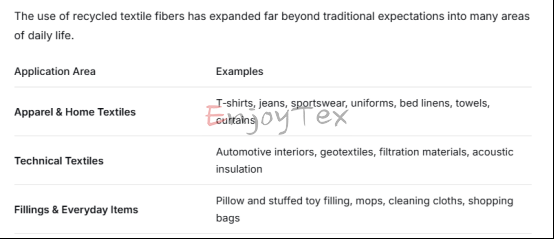
Wide Applications: More Than Just a T‑Shirt
✅ Certifications & Standards
To verify their sustainability credentials, recycled textile products commonly apply for internationally recognized certifications, and their development is guided by national standards.
- GRS (Global Recycled Standard) – The most rigorous international certification. Requires ≥20% recycled content and audits the entire supply chain for environmental compliance, social responsibility, and chemical management.
- RCS (Recycled Claim Standard) – A more basic certification that only tracks recycled content and its origin, with a minimum requirement of 5% recycled material.
- OEKO‑TEX Standard 100 – A product safety certification ensuring textiles are harmless to human health.
- Chinese National Standards – China has issued guidelines such as the Industry Standard Conditions for Recycled Chemical Fibers (Polyester) to regulate and promote sustainable development.
3.Summary
Recycled textile fibers from waste materials – through mechanical, chemical, or enzymatic technologies – transform discarded textiles into high‑quality new fibers. This conserves virgin resources (petroleum, cotton, etc.) and significantly reduces the carbon footprint of the textile industry. It serves as a core engine for moving the textile sector toward a green, low‑carbon, circular economy.
RELATED NEWS
- (QA)Causes and Solutions for Fabric Underweight 2026-05-28
- Causes and Solutions for Fabric Underweight 2026-05-28
- (QA)Causes and Solutions for Inconsistent Fabric Width 2026-05-28
- Causes and Solutions for Inconsistent Fabric Width 2026-05-28
- (QA) Analysis of Causes and Solutions for Common Fabric Problems -- Causes and S 2026-05-25
CATEGORIES
LATEST NEWS

CONTACT US
Contact: Jennie Feng
Phone: +86 18605718133
E-mail: info@enjoytex.com.cn
Whatsapp:+86 18605718133
Add: A206,10# Xiyuan Road Xihu District,Hangzhou City,310030 China