Blog
RPET Fabric
RPET fabric (Recycled PET fabric), commonly known as "Coke bottle eco-fabric," is a textile material made by recycling waste PET plastic bottles (e.g., water bottles, soda bottles) and reprocessing them into new fibers. As a type of renewable fabric, its core value lies in transforming "plastic waste" into "textile fabric."
Core Concept: How It Works
Imagine a used plastic bottle being recycled, undergoing a series of physical and chemical processes, and ultimately becoming the fabric for a T‑shirt or a backpack. That is the principle behind RPET fabric. Chemically, it is identical to virgin polyester made from petroleum, but its source is waste — making it a classic example of the circular economy.
Key Production Process: From Plastic Bottle to Fabric
Producing RPET fabric is a typical process of turning waste into a resource. The main steps are as follows:
1. Collection & Sorting – Waste PET bottles are collected, inspected, and sorted. Labels, caps, and other impurities are removed.
2. Shredding & Cleaning – The clean, sorted bottles are crushed into flakes and thoroughly washed.
3. Melting & Extrusion – The PET flakes are melted at high temperatures and then extruded through a spinneret to form continuous filaments. This is the core step, as it transforms solid plastic into textile fibers.
4. Cooling & Winding – The extruded filaments are cooled and wound onto bobbins to form yarn.
5. Fabric Formation – The recycled PET yarns are woven or knitted into various types of fabric.
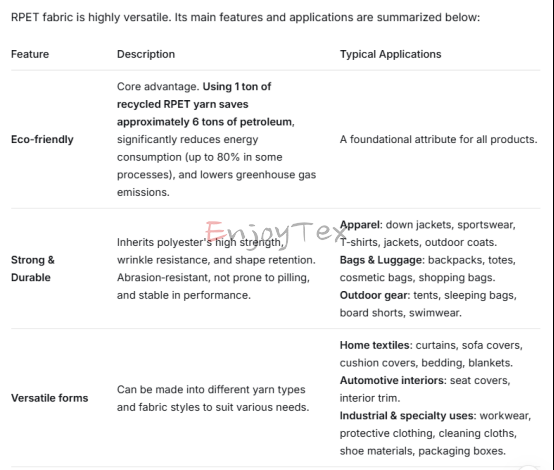
Key Characteristics & Applications
Limitations & Challenges
Despite its promising future, RPET fabric faces several practical challenges:
- Relatively high cost – Although the raw material is waste, the full‑chain technical requirements and certification costs for collection, sorting, washing, and reprocessing often make RPET more expensive than virgin polyester.
- Potential performance differences – Some recycling processes may result in fiber strength and uniformity slightly inferior to high‑quality virgin polyester.
- Microplastic issue – Like all synthetic fabrics, RPET releases microplastics during washing, an environmental issue that still needs to be addressed.
- Strict certification requirements – To prove its eco‑credentials, RPET fabric typically needs certifications such as the Global Recycled Standard (GRS) , which adds compliance costs and management complexity.
Summary
In summary, RPET fabric is a successful technological practice that turns "waste" into "resources." While meeting functional needs such as durability and ease of use, it provides an effective solution to plastic pollution and reduces dependence on fossil fuels. Despite challenges like cost, under the global trend of sustainable development, its application range is expanding from early uses (bags, apparel) into broader fields such as automotive interiors and home textiles.
RELATED NEWS
- (QA)Causes and Solutions for Fabric Underweight 2026-05-28
- Causes and Solutions for Fabric Underweight 2026-05-28
- (QA)Causes and Solutions for Inconsistent Fabric Width 2026-05-28
- Causes and Solutions for Inconsistent Fabric Width 2026-05-28
- (QA) Analysis of Causes and Solutions for Common Fabric Problems -- Causes and S 2026-05-25
CATEGORIES
LATEST NEWS

CONTACT US
Contact: Jennie Feng
Phone: +86 18605718133
E-mail: info@enjoytex.com.cn
Whatsapp:+86 18605718133
Add: A206,10# Xiyuan Road Xihu District,Hangzhou City,310030 China