Blog
REACH OF EU
REACH Testing Guidelines for Textiles (2024 Update)
Textiles exported to the EU must comply with REACH regulations, with a focus on testing restricted substances and Substances of Very High Concern (SVHC). Below is a detailed explanation of the testing scope, methods, and compliance procedures.
1. Testing Scope
(1) REACH Annex XVII (Restricted Substances)
Covers prohibited or restricted chemicals in textiles. Common testing items include:
Substance/Category | Limit | Applicable Products | Testing Standard |
Azo dyes (AZO dyes)
| ≤30 mg/kg (carcinogenic amines) | Skin-contact textiles (clothing, underwear, etc.) | EN 14362-1/ISO 17234-1 |
Cadmium (Cd)
| ≤100 ppm (plastics/coatings)
| Textiles with plastic/coatings (prints, accessories) | EN 1122 / ISO 3856-1
|
Lead (Pb)
| ≤100 ppm (accessible parts) | Metal accessories (buttons, zippers) | CPSC-CH-E1003-09.1 |
Nickel (Ni) release
| ≤0.5 µg/cm²/week
| Metal components (jewelry, zippers) | EN 1811 / EN 12472
|
Phthalates (6P)
| ≤0.1% (1000 ppm)
| Plastic/PVC components (shoes, bags, raincoats) | EPA 3540C / EN 14372
|
Perfluorooctanoic acid (PFOA) | ≤0.025 mg/m² | Water/oil-repellent coatings (outdoor wear) | EPA 8327 / OECD 506
|
Nonylphenol (NP/NPE) | ≤100 ppm | Dyeing auxiliaries residue | ISO 18254-1
|
(2) SVHC (Substances of Very High Concern) Screening
- If textiles contain SVHC substances (241 substances as of 2024) at concentrations >0.1% (w/w), they must be reported to ECHA (if annual export volume >1 ton).
- Common SVHCs in textiles: PFAS (waterproofing agents), hexavalent chromium (leather), organotins (antibacterial finishes).
2. Testing Methods
(1) Laboratory Testing Process
1. Sampling: Follow ISO 2859-1 to select representative samples (e.g., fabric, accessories, coatings).
2. Sample Preparation: Use extraction methods (e.g., Soxhlet extraction, microwave digestion) based on substance properties.
3. Instrumental Analysis:
- GC-MS (Gas Chromatography-Mass Spectrometry): Detects azo dyes, phthalates.
- ICP-MS (Inductively Coupled Plasma Mass Spectrometry): Detects heavy metals (Cd, Pb, Ni).
- HPLC (High-Performance Liquid Chromatography): Detects PFOA, nonylphenol.
4. Report Issuance: Provide ISO/IEC 17025-compliant test reports (e.g., from SGS, TÜV, Intertek).
(2) Rapid Screening Methods
- XRF (X-ray Fluorescence): On-site screening for heavy metals (Pb, Cd).
- ELISA Kits: Preliminary screening for azo dyes or PFAS.
3. Testing Costs and Turnaround Time
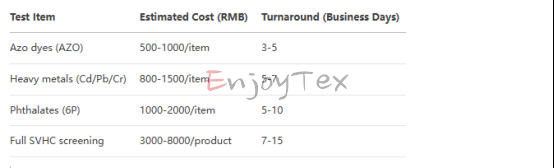
> Note: Costs vary by laboratory, sample quantity, and test items. Bulk testing may reduce unit costs.
4. Compliance Recommendations
1. Supply Chain Management:
- Require suppliers to provide REACH compliance declarations + third-party test reports.
- Conduct batch sampling for high-risk materials (e.g., coatings, dyes).
2. Product Tiered Testing:
- Children’s textiles (e.g., kids' clothing, diapers): Prioritize phthalates and azo dyes.
- Functional fabrics (waterproof, flame-retardant): Focus on PFAS and organotins.
3. SCIP Database Notification:
- If SVHC content >0.1%, submit information to ECHA’s SCIP database (importer’s obligation).
5. Frequently Asked Questions (FAQ)
Q1: Does REACH testing apply to all textiles?
- Yes, including apparel, home textiles, footwear, bags, and other textile-containing products.
Q2: How long is the test report valid?
- Typically 1 year, but retesting is required if the supply chain or regulations change (e.g., SVHC list updates).
Q3: How to choose a testing lab?
- Prefer EU-accredited labs (e.g., SGS, BV, TÜV) or CNAS/CMA-certified labs.
Q4: What’s the difference between REACH and OEKO-TEX® Standard 100?
- REACH is an EU legal requirement, while OEKO-TEX® is a voluntary certification (but covers some REACH requirements).
Summary
REACH testing for textiles must focus on restricted substances + SVHC, ensuring compliance through lab testing + supply chain control. Recommendations:
1. Monitor updates on ECHA’s website ([https://echa.europa.eu](https://echa.europa.eu)).
2. Partner with professional labs for long-term compliance strategies.
3. Increase testing frequency for high-risk products (e.g., children’s items, functional fabrics).
RELATED NEWS
- (QA)Causes and Solutions for Fabric Underweight 2026-05-28
- Causes and Solutions for Fabric Underweight 2026-05-28
- (QA)Causes and Solutions for Inconsistent Fabric Width 2026-05-28
- Causes and Solutions for Inconsistent Fabric Width 2026-05-28
- (QA) Analysis of Causes and Solutions for Common Fabric Problems -- Causes and S 2026-05-25
CATEGORIES
LATEST NEWS

CONTACT US
Contact: Jennie Feng
Phone: +86 18605718133
E-mail: info@enjoytex.com.cn
Whatsapp:+86 18605718133
Add: A206,10# Xiyuan Road Xihu District,Hangzhou City,310030 China