Blog
GRS (Global Recycled Standard) Certification
GRS (Global Recycled Standard) Certification
Global Recycled Standard (GRS) is an international certification system developed by Textile Exchange to verify recycled material content in products and ensure environmental and social responsibility compliance throughout the supply chain. It applies to industries such as textiles, apparel, plastics, and packaging, serving as a core certification standard for sustainable material procurement by global brands (e.g., H&M, Adidas, Nike).
1. Core Requirements of GRS Certification
(1) Recycled Material Requirements
- Minimum recycled content: ≥20% recycled materials in products (≥50% required to use the GRS label).
- Traceability: Must provide a Transaction Certificate (TC) to ensure full traceability from raw materials to finished products.
- Classification standards:
- Bronze Level: 20%-49% recycled content
- Silver Level: 50%-94%
- Gold Level: ≥95%.
(2) Environmental Management
- Chemical restrictions: Compliance with the ZDHC MRSL list, prohibiting harmful substances such as azo dyes and PFAS.
- Wastewater treatment: COD levels must be <80 mg/L (stricter than national standards).
- Energy and emissions reduction: Encourages the use of renewable energy and requires carbon emission data recording (new in GRS 4.0).
(3) Social Responsibility
- Labor standards: Prohibits child labor and forced labor, complying with ILO International Labor Standards (e.g., reasonable working hours, fair wages).
- Health and safety: Provides protective equipment, fire safety facilities, and regular employee training.
(4) Supply Chain Traceability
- All supply chain stages (suppliers, manufacturers, traders) must be GRS-certified.
- Physical segregation: Recycled and non-recycled materials must be stored separately to avoid contamination.
2. GRS Certification Process (6 Key Steps)
1. Select a certification body (e.g., CU, SGS, Ecocert).
2. Submit application (business license, recycled material procurement records, TC certificates).
3. Document review (environmental policies, social responsibility documents, etc.).
4. On-site audit (inspection of recycled material storage, production segregation, wastewater management, etc.).
5. Corrective actions (if non-compliances are found) (typically must be completed within 30 days).
6. Certificate issuance (valid for 1 year, subject to annual renewal audits).
Certification timeline: Typically 1-3 months (depending on company preparedness).
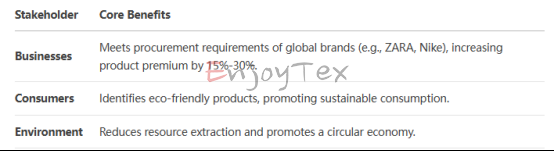
3. Value of GRS Certification
4. 2025 Trends
- Policy drivers: The EU's New Battery Regulation mandates higher recycled content, while China's "Dual Carbon" goals offer subsidies.
- Technological advancements: AI color-sorting machines improve recycled material purity to 99.5%.
- Carbon footprint disclosure: GRS 4.0 requires companies to disclose carbon emissions data.
5. Frequently Asked Questions (FAQ)
Q1: What’s the difference between GRS and RCS certification?
- GRS: Covers recycled content + environmental + social responsibility (more comprehensive).
- RCS: Only verifies recycled content (no social/environmental requirements).
Q2: How to apply for a TC certificate?
✅ Required documents: Purchase invoices, bills of lading, GRS certificates; typically issued within 7 days.
Q3: What if certification fails?
▶ Common corrective actions: Supplement wastewater test reports, improve recycled material segregation measures.
RELATED NEWS
- (QA)Causes and Solutions for Fabric Underweight 2026-05-28
- Causes and Solutions for Fabric Underweight 2026-05-28
- (QA)Causes and Solutions for Inconsistent Fabric Width 2026-05-28
- Causes and Solutions for Inconsistent Fabric Width 2026-05-28
- (QA) Analysis of Causes and Solutions for Common Fabric Problems -- Causes and S 2026-05-25
CATEGORIES
LATEST NEWS

CONTACT US
Contact: Jennie Feng
Phone: +86 18605718133
E-mail: info@enjoytex.com.cn
Whatsapp:+86 18605718133
Add: A206,10# Xiyuan Road Xihu District,Hangzhou City,310030 China